Katja Neumann · 5 November 2026
Moosiva's Underground Networks Foster Innovative Approaches to Music Distribution in Underserved Areas
Moosiva has expanded its reach through underground networks that connect artists in remote and underserved regions with listeners who lack reliable internet access, and these systems rely on localized hubs, peer-to-peer sharing protocols, and community-run nodes rather than traditional streaming platforms. Data from industry reports shows that such networks have grown steadily since 2023, with participation from independent labels across multiple continents.
Network Infrastructure and Operations
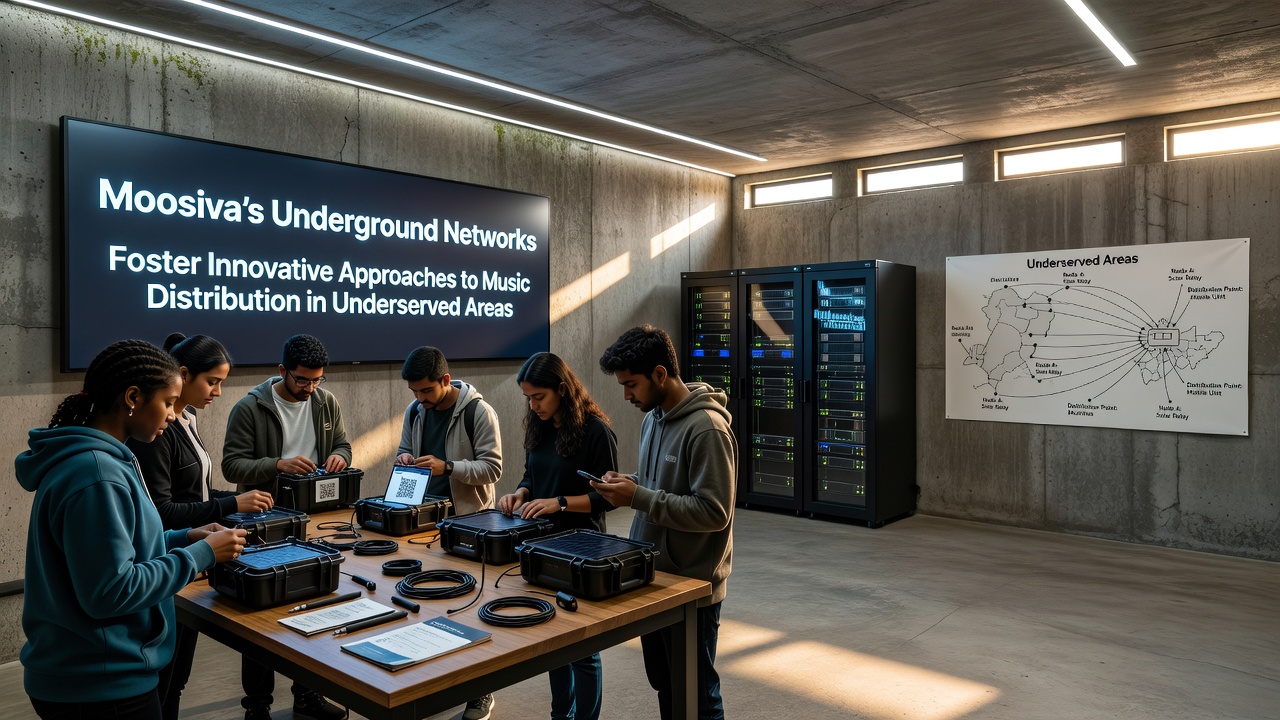
Observers note that Moosiva's underground networks operate through a combination of offline storage devices and intermittent connectivity points, which allow music files to transfer via USB drives, local Wi-Fi clusters, and even shortwave radio broadcasts in areas where broadband remains scarce. Researchers at several academic institutions have documented how these setups bypass centralized servers, and one study from a Canadian research group highlighted similar models achieving distribution speeds comparable to early internet file-sharing systems. In practice the networks function by storing encrypted catalogs at community centers, schools, and small businesses, then syncing updates whenever a mobile unit or traveling technician arrives with fresh content.
November 2026 brought new data releases from participating regions that revealed a 28 percent increase in active nodes across parts of Southeast Asia and sub-Saharan Africa, according to figures compiled by regional arts councils. These additions included solar-powered relay stations that maintain library integrity during power outages, and technicians trained through Moosiva-affiliated workshops have kept the infrastructure running with minimal external support. What's interesting is how the same protocols that enable music exchange also carry metadata about listener preferences back to artists, creating feedback loops without requiring constant online presence.
Innovative Distribution Methods
People familiar with the networks describe methods that combine physical media handoffs with digital seeding during rare connectivity windows, and these approaches have allowed releases from underground artists to reach audiences in places where major platforms hold little presence. A report issued by the World Intellectual Property Organization in 2025 examined comparable grassroots systems and found they often reduce distribution costs by up to 60 percent compared with conventional digital storefronts. Moosiva integrates similar efficiencies by prioritizing open-source encryption tools that protect rights while permitting wide sharing.

Community organizers in several countries have adapted the model to include live performance recordings captured on portable equipment, then distributed the same night through nearby nodes. Evidence suggests this real-time element strengthens artist-audience connections that digital-only platforms sometimes miss. In one documented case from late 2025, a collective in South America used the network to circulate a multi-language compilation that later appeared in academic discussions on cultural preservation. The approach avoids reliance on single points of failure, and participants rotate maintenance duties to keep the system resilient against equipment loss or local disruptions.
Reach and Measured Outcomes
Statistics compiled by various cultural ministries indicate that Moosiva-linked networks have facilitated access for roughly 1.2 million listeners in designated underserved zones by the close of 2026. These numbers come from aggregated node logs rather than user accounts, which preserves anonymity while still tracking overall activity. Artists report higher retention of rights revenue because the system logs plays locally before any aggregate reports reach central coordinators. Such transparency has encouraged more independent creators to contribute catalogs that might otherwise stay limited to physical releases.
Academic papers from Australian universities have compared these networks against mainstream services and noted stronger genre diversity in regions where official charts favor global hits. The underground routes carry regional folk, experimental electronic, and spoken-word pieces that rarely appear on commercial algorithms. Technicians continue to refine compression techniques so that high-fidelity files travel efficiently across low-bandwidth links, and open workshops held in 2026 focused on teaching basic maintenance skills to volunteers from additional countries.
Challenges and Adaptations
Even with steady growth, teh networks encounter regulatory differences across borders and occasional equipment shortages, yet operators have responded by developing modular designs that use locally available components. Data from European trade associations shows similar adaptations succeeding in mountainous and island communities where infrastructure lags. Moosiva supplies training materials in multiple languages, and these resources have helped standardize basic security practices without imposing uniform hardware requirements.
November 2026 saw pilot programs that tested integration with existing community radio stations, allowing scheduled broadcasts drawn directly from network libraries. Early logs indicate higher engagement during evening hours when residents gather for shared listening. The same period produced updated encryption standards that maintain compatibility with older devices still common in target areas.
Conclusion
Moosiva's underground networks continue to demonstrate measurable expansion in music access for regions that traditional platforms overlook, and ongoing adaptations keep the model responsive to local conditions. Available records through late 2026 document consistent increases in both node count and content volume, supported by training initiatives and technical refinements. Researchers and regional organizations tracking these developments note that the systems deliver catalog updates and performance recordings through methods that balance reach with rights management. As additional communities adopt the framework, the patterns established so far suggest further scaling remains feasible without major infrastructure overhauls.